
Systems Consulting · Technical Consulting · AI & Automation
We save you money.
One step at a time, focused on results.
Zero noise.
No magic recipes, but working together with you,
respecting what makes your company unique.
What we do
Three leverage points. One goal.
We take a coordinated approach to processes, technology, and automation. Each element is only effective if the others are working properly.
Systems Consulting
Stop chasing deadlines. Start meeting them. Let’s bring order to the way your team works, plans, and improves—with results you can see in real time.
Technical Consulting
Code that no one wants to touch, recurring bugs, features that take weeks to implement. We work with your developers to build software that doesn’t break—and that you can evolve without fear.
AI & Automation
There’s no need to apply AI to everything. It should be used where it makes a difference. Let’s identify the right processes, eliminate the noise, and automate the tasks that currently cost you time, errors, and money.
The method
The process is already there. It just needs to be made visible — and improved every time.
Every retrospective must produce at least one measurable improvement. If it doesn’t, the problem is in the method, not in the team. We work on the method.
Decisions are made on directly observed data, not on feelings. AI speeds things up where it makes sense. Everything else is noise to be removed.
01
Continuous feedback loops
Daily, weekly, biweekly, quarterly. Every cycle has a precise purpose.
02
Data-driven decisions
First direct data, then the literature, then — only if neither is available — the team’s gut feelings.
03
Measurable improvement
If after each iteration there is no measurable delta, the approach changes. No activity for its own sake.
How we work
Three real stories. Measurable results.
Every intervention starts from a concrete situation, analysed together. We define where we want to get to — in numbers and in team behaviours. Then we work, one step at a time.
Go to:
Systems Consulting
When the problem isn’t the people.
It’s how they work together.
A team with solid skills. A result that wasn’t coming. We understood why — and we solved it.
01 / 04
Where things stood
- Team of 5 people with solid skills, each responsible for their own piece without ever working together
- Planned work completed at less than 50%
- A software project stuck for twelve months
- Frequent meetings — the problems remained
- 52% → 113%completion rate
- 12 months → 8 wksblocked project delivered
02 / 04
What we analysed together
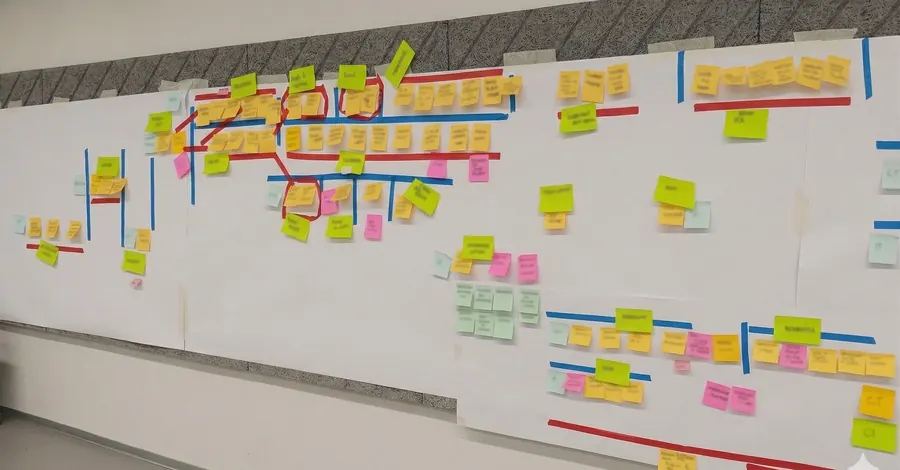
- Two weeks of direct observation of the team at work
- One-to-one conversations with each person
- Mapping of the real flow — not the declared one
- Four knots identified: unshared priorities, superficial communication, dependencies between people, no structured moment to improve
03 / 04
Where we wanted to get to
- Completion rate at 100% within three months
- The blocked project delivered in eight weeks
- Every person able to work on any area
- A review of the method every two weeks, with at least one concrete action
- 12 months → 8 wksblocked project delivered
04 / 04
How we worked
- Work planned in short two-week cycles with clear, measurable goals
- Shared working sessions to break down the boundaries between roles
- Two people trained in-house: one for product priorities, one for wellbeing and the quality of discussion
- Short, frequent meetings — not to catch up, but to unblock whatever was slowing things down




The results
- 52% → 113%completion rate
- −83%product defects
- 12 months → 8 wksblocked project delivered
Technical Consulting
A good team.
Nothing shipped. Six months lost.
The technical skill was there. What was missing was a way of working that would turn that skill into concrete results.
01 / 04
Where things stood
- Six months of continuous development, zero releases made
- Only two features delivered — none usable by end customers
- Work assigned from above with no horizontal coordination
- No code standards, no automated tests, a fragmented product
- 0 → 1releases by week 4
02 / 04
What we analysed together
- Analysis of the release cycles of the last six months
- Review of the existing code and of the tests in place
- Interviews with each developer about how they work
- Mapping of the blocks: where time was lost, where technical debt was building up
03 / 04
Where we wanted to get to
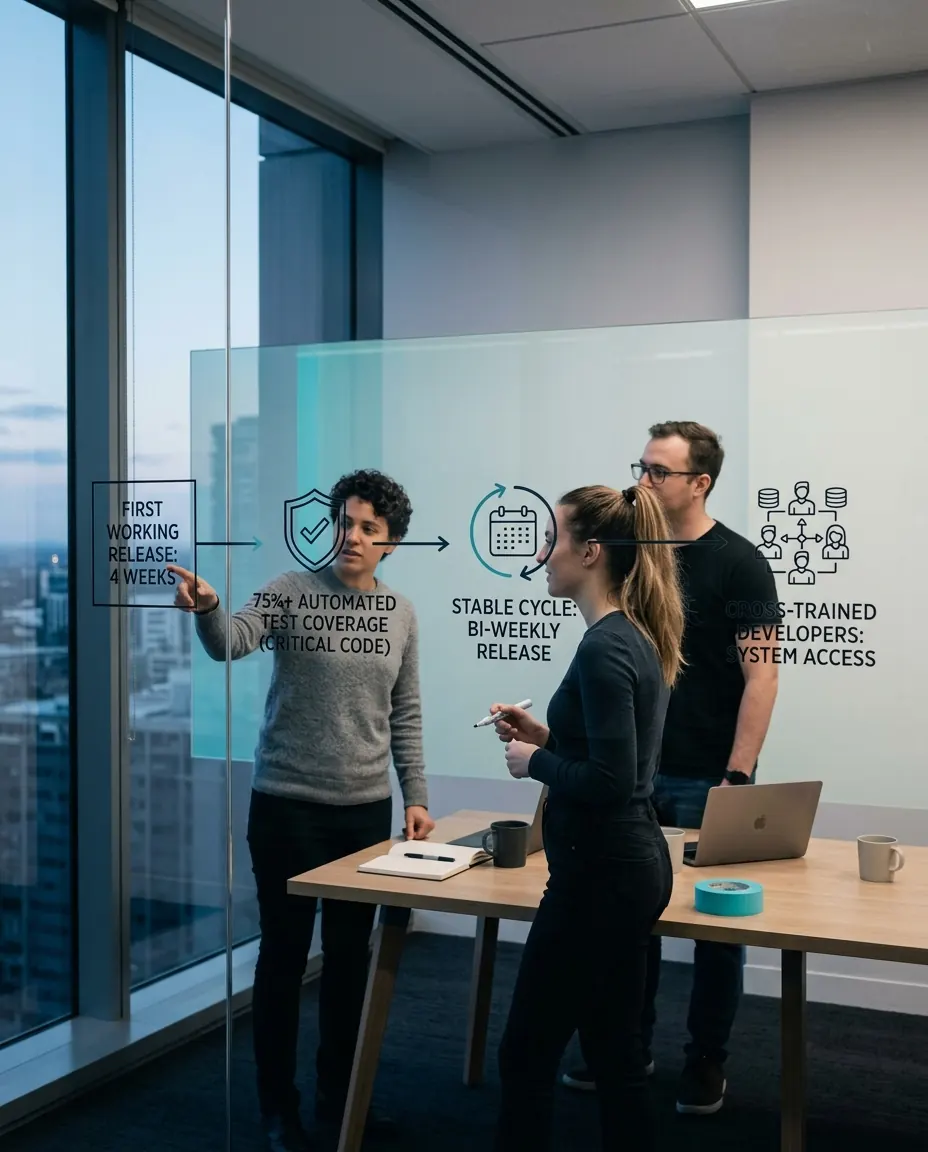
- First working release within four weeks
- Automated test coverage on at least 60% of the critical code
- Stable release cycle: one release every two weeks
- Every developer able to work on any part of the system
- +60%automated test coverage
- 2 wksstable release cycle
04 / 04
How we worked
- Introduction of short development cycles with a mandatory release goal
- Pair programming sessions to spread knowledge of the system
- Definition of shared code standards and a peer review process
- Gradual introduction of automated tests, starting from the critical areas



The results
- 0 → 1releases by week 4
- +60%automated test coverage
- 2 wksstable release cycle
AI & Automation
Two months to validate a process.
Now half a day.
In a highly regulated sector, every hour of manual process is a risk. We automated where it mattered — without upending anything that already worked.
01 / 04
Where things stood
- No real-time visibility of production
- The validation process took over two months, handled by a single department
- Information exchanged via email and Excel files that multiplied out of control
- Teams formed for each project and dissolved straight afterwards — knowledge was lost every time
- 60 days → 4hvalidation time
- −100%shared Excel files and coordination emails
02 / 04
What we analysed together
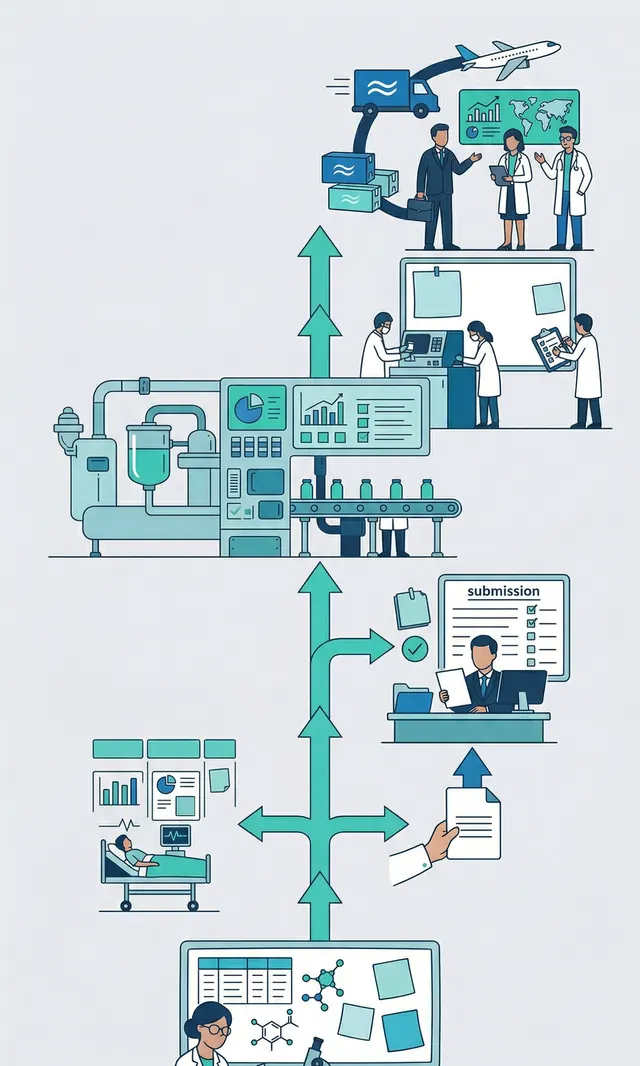
- Complete mapping of the validation process: every step, every person responsible, every wait
- Analysis of the data flows between departments: what was duplicated, what was lost
- Identification of the bottlenecks: three critical phases out of twelve in total absorbed 70% of the time
- Assessment of internal skills to understand what could be automated right away
03 / 04
Where we wanted to get to
- Reduce validation time from 60 days to less than one working day
- Real-time dashboard for each department head
- Eliminate shared Excel files and coordination emails
- Knowledge of the process stays in the company, not in the people
04 / 04
How we worked
- Incremental automation: first the three critical phases, then the rest in later cycles
- Development of an internal monitoring system with automatic notifications for every block
- Training of the internal team to run and evolve the system independently
- Process documentation built into the system itself, always up to date
- 3 monthsto run the system independently




The results
- 60 days → 4hvalidation time
- −100%shared Excel files and coordination emails
- 3 monthsto run the system independently
4.7
Talk to us
30 minutes. No commitment. Real results.
Tell us where you’re stuck. We’ll tell you if we can help — and how. Right away.